
Preclinical Immunology Services

Vacara AB provides preclinical study services using proprietary humanized disease models designed to improve translational relevance in immune-mediated diseases. Our platform enables evaluation of therapeutic efficacy, immune mechanisms, and disease-modifying activity in models that recapitulate human immune responses, thus supporting decision-making from early discovery through preclinical development.


Our Services

  • Preclinical Efficacy Studies

Evaluation of therapeutic candidates in humanized models to assess disease-modifying effects and treatment response. Applications include biologics, immunomodulators, vaccines, and autoimmunes therapies.

  • Mechanistic & Translational Studies

Characterization of immune pathways and generation of decision-driving datasets. Supports target validation, immune profiling, and translational alignment with human disease.

  • Biomarker & Immune Readouts

Integrated analysis of immune responses to support mechanistic understanding. Includes autoantibodies, cytokines, and cellular immune profiling.


Humanized Disease Model Platform

All studies are conducted in Vacara’s proprietary humanized models, featuring:

  • Human HLA-driven immune responses 
  • Disease-relevant T-cell and B-cell interactions 
  • Autoantibody production capability 
  • Enhanced translational relevance compared to conventional models

Learn more about our humanised models


Vacara Study Workflow

Vacara works closely with partners to deliver high-quality results:

  • Study Design: We work with partners to define objectives and endpoints. 
  • Study Execution: Studies are conducted in-house by Vacara’s experienced scientists using proprietary platforms 
  • Data & Analysis: Integrated immunological readouts, including disease scoring and immune profiling, are generated.
  • Reporting: Full data package are delivered with interpretation and follow-up options


Applications

Our services support programs in:

  • Autoimmune diseases (e.g. rheumatoid arthritis)
  • Immuno-oncology and checkpoint biology 
  • Inflammatory disease mechanisms 
  • Tolerance-inducing therapies 
  • Early translational validation of novel drug candidates 


Why Vacara

  • Decades of scientific expertise in immunology and in vivo models
  • Humanized models enabling clinically relevant immune responses 
  • Strong alignment with human disease mechanisms 
  • Integrated end-to-end study execution


Study Examples

Study 1: CIA Model – Therapeutic Efficacy in Humanized RA System

In a collagen-induced arthritis (CIA)-based humanized model, therapeutic candidates were evaluated for their ability to modulate disease progression and immune response. A study based on Vacara’s humanised model was published in Molecular Therapy (link to publication).
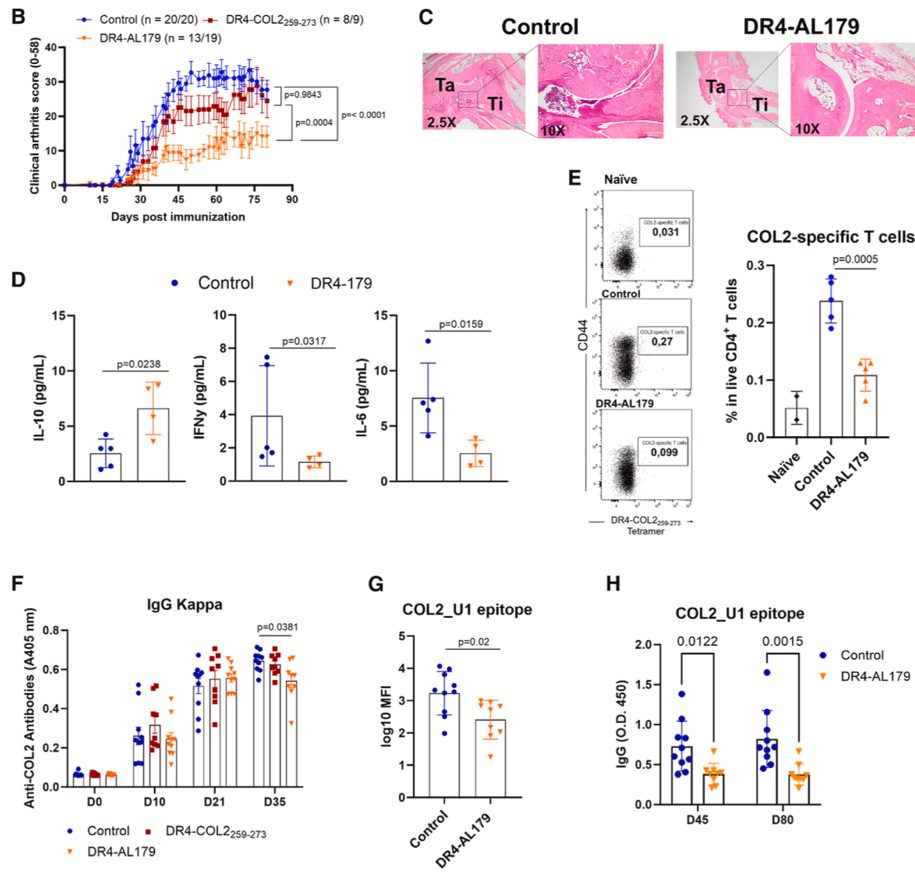

Key analysis and outcomes:

  • Clinical arthritis score (panel B): The efficacy of the vaccine was evaluated in collagen-induced arthritis. Treatment group (in orange) exhibited reduced incidence and severity of arthritis in comparison with the control (in blue). 
  • Histological analysis of the joints (panel C): The therapeutic effect of the vaccine was supported by histological analysis of the paw sections, revealing reduced immune cell infiltration and bone erosion along with enchanted preservation of collagen fibre structure compared to the control group.  
  • Serum cytokine response (panel D): The serum on day 20 post immunisation was analysed for different cytokines. The treatment group showed elevated level of anti-inflammatory IL-10 cytokine and a reduction in the pro-inflammatory cytokines IFN-γ and IL-6.
  • Autoantibody response (panel F): The serum on day 45 post immunisation was analysed for anti-COL2 IgG. The treatmente group exhibited reduced in anti-COL2 IgG antibody levels in comparison with the control group. Further studies by a bead-based immunoassay revealed reduction of the arthritogenic U1 antibody levels during both the acute phase of disease at day 45 post immunization (Panel G) and at the terminal point (Panel H).


Study 2: CIA Model – Mechanistic Evaluation of Immune Modulation

A second CIA-based study focused on dissecting immune mechanisms (focusing on T cells) underlying disease suppression in a humanized RA model.
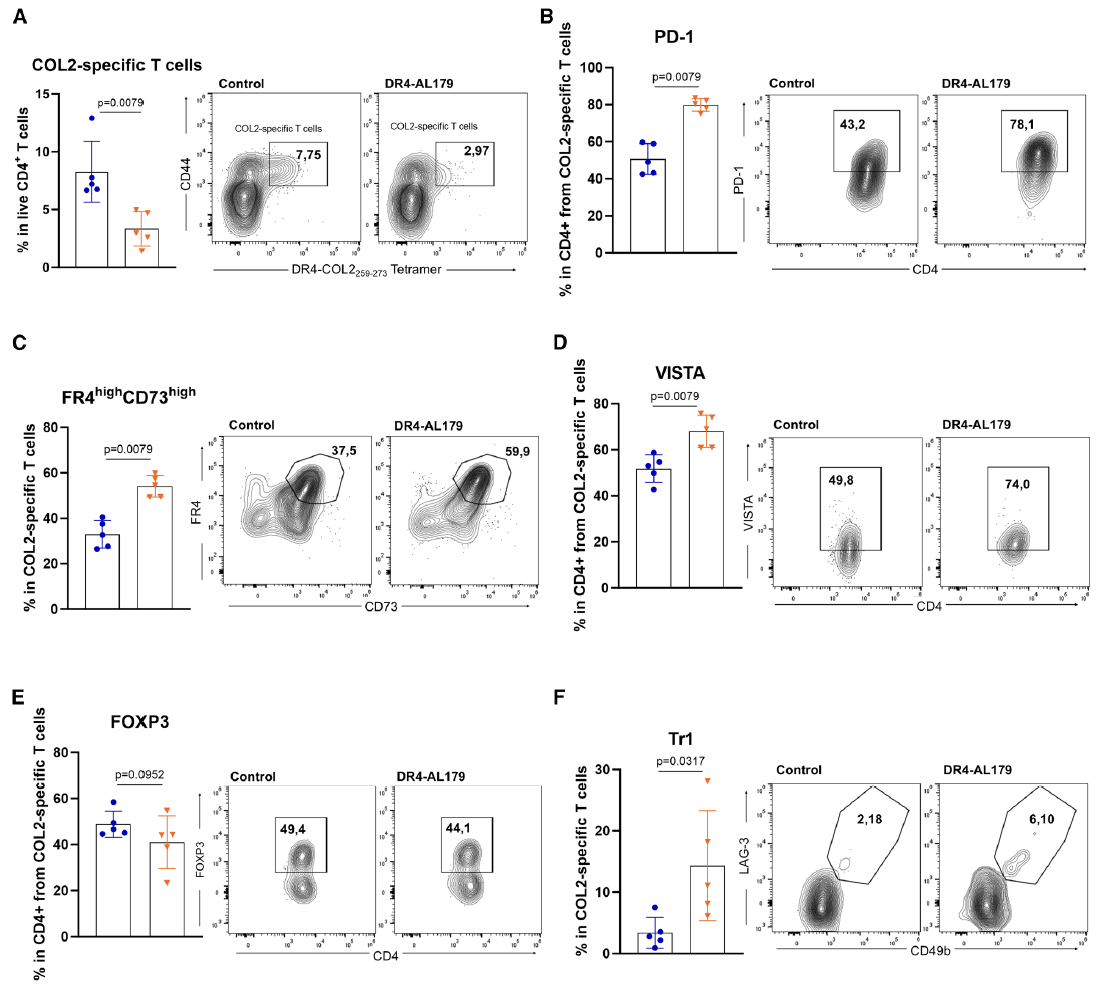
Key analysis and outcomes:

  • Flow cytometry analysis: Performed on splenocytes and lymph nodes day 15 post immunisation, treatment group showed reduction in the number of COL2-specific T cells (panel A). This was followed by analysis of tolerogenic phenotype, including PD-1 expression (panel B), CD73, folate receptor 4 (FR4) (panel C) and VISTA (panel D) and also different markers of regulatory T cell markers such as Foxp3 and Tr1 (panels E and F). The results showed that the treatment reduced antigen-specific T cells while shifting the immune response toward a tolerogenic phenotype, predominantly inducing non-classical regulatory (Tr1) cells rather than conventional FOXP3+ Tregs. Further analysis and discussion can be found here.


Access Models

Our services can be accessed through various options. For details, please see our partnership and licensing page or contact us directly to discuss. 


Next steps


.